For global buyers, Bess Battery Energy is no longer a distant technology category. It is a practical purchasing decision with financial, operational, and safety consequences. Factories, ports, hospitals, and renewable projects need dependable power during peak demand. A battery system can reduce grid pressure, store solar energy, and improve energy resilience. The value appears on site.
Real projects are rarely perfect. Temperature changes, limited space, weak grid connections, and complex installation schedules can affect performance. Buyers should examine usable capacity, round-trip efficiency, response time, degradation, and expected cycle life. Nameplate capacity alone can mislead. A 10 MWh system may deliver less usable energy after reserve limits and operating conditions.
Experienced procurement teams request verified test reports, warranty terms, fire-safety documentation, and supplier references. They also compare factory quality controls, software capabilities, maintenance support, and spare-part availability. Independent inspections can reveal gaps that sales brochures hide. Regional grid rules and product requirements also differ, so local technical advisors should confirm compliance before ordering. This is not a minor detail.
The strongest purchasing decision connects battery performance with a clear business case. Buyers can model demand charges, renewable curtailment, backup needs, financing costs, and replacement risks. They should ask how the system performs after several years, not only on delivery day. Some forecasts remain uncertain. That uncertainty deserves a visible contingency plan. Careful evaluation helps global buyers choose a BESS solution that is safer, more transparent, and better matched to real operating conditions.
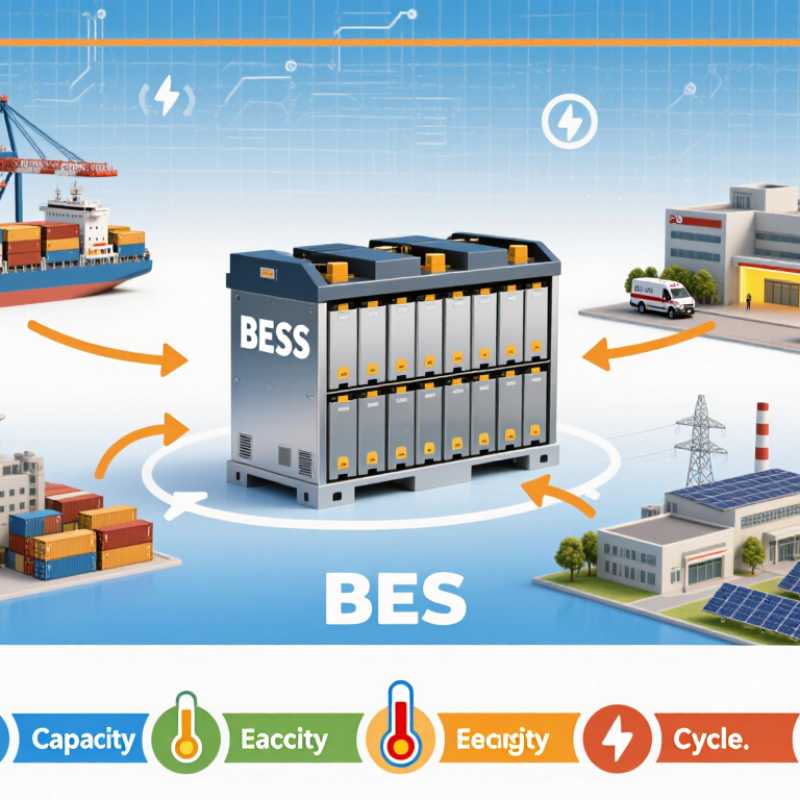
Battery Energy Storage Systems, or BESS, store electricity for use when generation or demand changes. A typical installation combines battery cells, racks, a battery management system, inverters, cooling, fire protection, and site controls. During charging, the inverter converts alternating current into direct current for the battery. During discharge, that process reverses and sends usable power to loads or the grid. The control system watches voltage, temperature, state of charge, and available capacity every second. Small details matter. A poorly balanced cell can reduce performance, even when the displayed capacity looks healthy.
For global buyers, BESS value depends on the job it must perform. It may shift midday solar into an evening peak, stabilize frequency, provide backup power, or reduce demand charges. These services require different power ratings, energy durations, response times, and operating limits. A two-megawatt system delivering power for one hour is not equivalent to a one-megawatt system lasting four hours. Project evaluation should include round-trip efficiency, degradation assumptions, warranty terms, monitoring access, maintenance procedures, and local grid requirements. Heat changes the picture. High ambient temperatures can increase cooling demand and accelerate aging if thermal controls are weak. A neat spreadsheet can still miss installation constraints, emergency access, or replacement logistics. Independent testing and clear performance data make comparisons more reliable, although no forecast is perfect.
A Battery Energy Storage System (BESS) stores electricity in batteries and releases it when needed. For a 100 MW BESS, usable energy increases directly with its discharge duration: Energy (MWh) = Power (MW) × Duration (hours).
Longer-duration systems can support renewable energy shifting, peak-demand management and grid reliability. Actual delivered energy may be lower because of operating limits, state-of-charge reserves and conversion losses.
Global energy buyers are purchasing flexibility, not simply stored electricity. A BESS can shift solar power from a bright afternoon to an evening peak, support frequency control, and reduce exposure to volatile spot prices. The International Energy Agency reports that global battery storage capacity must expand sixfold to reach 1,200 GW by 2030 in its net-zero pathway. That target changes procurement priorities.
Performance matters. NREL’s 2024 Annual Technology Baseline uses approximately 85% round-trip efficiency for utility-scale battery systems. Buyers should examine usable energy, degradation, auxiliary consumption, and response time rather than relying on nameplate capacity. A 100 MWh system will not deliver 100 MWh throughout its contract life. Small detail. Large financial impact.
Contract design also deserves scrutiny. Buyers need clear guarantees for availability, capacity retention, thermal safety, cybersecurity, and replacement responsibility. The Global Energy Monitor’s Battery Storage Tracker shows rapid growth in announced projects, but announcements are not operating assets. Permitting, interconnection queues, and local grid rules can delay revenue. Some early models may also overestimate merchant income. That weakness is worth admitting. A bankable BESS decision combines independent testing, conservative degradation assumptions, and site-specific dispatch modelling, while keeping emergency procedures visible to operators.
Why Bess Battery Energy Storage Matters for Global Buyers?
Key Benefits of BESS for Commercial and Industrial Applications
Commercial and industrial facilities rarely use electricity evenly. A factory may start several motors at once, while a warehouse faces sharp demand during cooling hours. A battery energy storage system (BESS) stores electricity during lower-cost periods and releases it during expensive peaks. This can reduce demand charges and make monthly energy costs easier to manage. The savings depend on local tariffs, operating schedules, and battery sizing.
BESS also supports power quality. It can respond quickly to voltage changes, short interruptions, and unstable renewable generation. For a facility with sensitive controls, that response may protect production from nuisance shutdowns. Solar panels become more useful when excess midday generation is stored for evening operations. Less energy is wasted. Still, battery systems are not a universal fix.
Site planning requires careful measurement. Engineers should review load profiles, fire protection, ventilation, thermal conditions, and grid connection rules. A poorly sized system may cycle too often or leave capacity unused. Battery performance also declines over time, even with responsible operation. Buyers should examine safety certifications, warranty terms, monitoring functions, maintenance access, and end-of-life procedures. The cheapest quotation can create expensive complications. Good decisions come from verified data, realistic operating assumptions, and regular performance reviews.
Global buyers should select a BESS by operating conditions, not headline capacity. The right system must match the grid, climate, and revenue model. A four-hour battery may suit renewable shifting, while a shorter system may support frequency control. IEA’s Batteries and Secure Energy Transitions report estimates that global battery storage capacity must reach about 1,200 GW by 2030 in its net-zero pathway. That scale makes careful procurement essential.
Start with usable energy, power output, degradation, and round-trip efficiency. Ask how performance changes at 45°C, during frequent cycling, and near the warranty limit. Safety design also matters. Buyers should examine thermal propagation testing, fire detection, emergency procedures, and independent certification. NREL’s 2024 Annual Technology Baseline presents battery costs through multiple duration and learning scenarios, showing why one quoted price can be misleading. It is not a complete comparison.
Local support can decide project performance. Check spare-part availability, remote monitoring, software compatibility, response times, and technician qualifications. Contract terms should define capacity retention, availability, response speed, and testing methods. Recycling plans deserve attention too. A strong warranty sounds useful, but unclear measurement rules can weaken it. I would not trust a spreadsheet alone. Site visits, reference checks, and independent technical due diligence often reveal practical problems. IRENA also emphasizes that storage value depends on system integration, not batteries alone. Procurement should therefore assess the inverter, energy-management system, grid connection, and operating controls together.
Renewable energy systems rarely produce power when demand is highest. Solar panels may generate strongly at noon, while households need more electricity after sunset. BESS stores this surplus and releases it during evening peaks. The result is a more flexible energy system, not simply a larger battery installation.
In project assessments, buyers should examine round-trip efficiency, usable capacity, response time, and expected degradation. A system rated at 10 MWh may deliver less energy after temperature limits and reserve requirements. That detail matters. Thermal management, fire detection, ventilation, and emergency isolation also require careful evaluation. Compliance with local grid codes should be verified before procurement, because connection rules differ between markets.
BESS can reduce renewable curtailment and support frequency control within seconds. It can also provide backup power for critical facilities when the grid becomes unstable. However, storage is not automatically economical. Revenue depends on electricity prices, operating cycles, financing costs, and market access. I have seen projects focus on battery size while overlooking software reliability and maintenance planning. That assumption can be expensive. Buyers need transparent performance data, realistic warranty conditions, and clear responsibility for system integration. Field conditions can be harsher than a laboratory model. Dust, humidity, weak grids, and delayed spare parts may change the original forecast. Good planning leaves room for these uncertainties.
| Buyer Priority | Typical BESS Parameter | How It Supports Renewable Energy | Procurement Considerations |
|---|---|---|---|
| Solar and Wind Energy Shifting | Energy duration: Commonly 2–4 hours for utility-scale projects | Stores excess solar or wind generation and dispatches it during evening peaks, low-wind periods, or other high-demand hours. | Assess usable energy, round-trip efficiency, augmentation strategy, and the expected number of full equivalent cycles per year. |
| Peak Demand Management | Discharge response: Typically sub-second to a few seconds | Reduces short-duration demand peaks and can lower the amount of electricity that must be supplied by peaking generators. | Compare power rating in MW with energy rating in MWh; a high-power system may require a shorter duration than an energy-shifting system. |
| Grid Frequency Regulation | Response time: Usually within milliseconds to seconds | Rapidly balances small differences between electricity generation and consumption, helping stabilize grids with variable renewable output. | Verify control-system compatibility, telemetry requirements, response accuracy, and availability during consecutive regulation events. |
| Renewable Curtailment Reduction | Operating mode: Charge during renewable oversupply and discharge when grid capacity is available | Captures renewable electricity that would otherwise be curtailed because generation exceeds local demand or transmission capacity. | Use local generation and curtailment data to size the system; project economics depend strongly on charging opportunities and market rules. |
| Round-Trip Efficiency | Typical lithium-ion system range: Approximately 85%–95% at system level, depending on operating conditions | Higher efficiency allows more stored renewable electricity to reach consumers and reduces energy losses during charging and discharging. | Request independently defined AC-to-AC efficiency, including inverters, transformers, cooling, auxiliary loads, and the stated operating temperature. |
| Cycle Life and Asset Longevity | Cycle life: Often about 4,000–10,000 equivalent full cycles for commercially used lithium-ion configurations | Long cycle life supports repeated daily renewable shifting and reduces the frequency of major battery replacement. | Review warranty throughput, end-of-life capacity definition, depth-of-discharge limits, calendar-life assumptions, and cell operating temperature. |
| Safety and Thermal Management | Key controls: Battery management system, thermal monitoring, ventilation, fire detection, and emergency isolation | Safe operation improves the reliability of renewable assets and supports stable operation in large-scale, distributed, and remote installations. | Evaluate applicable local fire codes, international test reports, spacing requirements, emergency response procedures, and system-level safety validation. |
| Grid Resilience and Backup | Backup duration: Commonly 1–4 hours, with longer durations requiring additional energy capacity | Provides backup power during outages and can support critical loads when renewable generation is unavailable or grid service is interrupted. | Define critical-load power, black-start capability, islanding requirements, transfer time, and the required state of charge before an outage. |
| System Scalability | Configuration: Modular power-conversion and battery blocks, scalable in MW and MWh | Allows storage capacity to expand alongside solar, wind, transmission, or electricity demand growth. | Confirm future expansion space, communication architecture, spare capacity, compatibility of later battery additions, and planned augmentation costs. |
| Environmental and Siting Factors | Operating conditions: Performance depends on temperature, humidity, altitude, and cooling design | Proper environmental design preserves efficiency, availability, and battery life across different climates and renewable project locations. | Check operating temperature range, ingress protection, corrosion resistance, noise limits, water use, recycling arrangements, and end-of-life handling. |
| Total Cost of Ownership | Cost drivers: Battery modules, power-conversion equipment, balance of plant, installation, maintenance, augmentation, and decommissioning | Transparent lifecycle costing helps buyers compare storage with grid upgrades, renewable curtailment, fossil-fuel peaking capacity, and electricity-market purchases. | Use levelized cost of storage or a project-specific cash-flow model instead of comparing battery purchase price alone. |
Rob was always very honest and upfront about everything and took the time to explain everything I needed.
“highly recommended. They provided us with a great storage container with ontime services.”
“Bought a used container, its perfect, no leaks and in good condition.”
“Good service and prompt delivery. A great option for temporary storage at a decent price.”

Join our mailing list to get the latest storage container inventory and offers