China Top 10 Industrial Ventilation Fan Manufacturers
Industrial ventilation is no longer a background utility hidden above a factory roof. It is a measurable control system for heat, dust, fumes, humidity, and worker comfort. The International Energy Agency reports that buildings account for nearly 30% of global final energy consumption. Industrial facilities add another challenge: large air volumes, harsh environments, and continuous operating schedules. A poorly selected Industrial Ventilation Fan can waste power every hour.
Market estimates also show sustained demand. Grand View Research values the global industrial fans market at billions of dollars and expects continued growth through the decade. MarketsandMarkets similarly identifies energy efficiency, process safety, and expanding manufacturing capacity as major drivers. These figures differ because researchers define “industrial fans” differently. That limitation deserves attention.
“Ventilation is the intentional introduction of clean air into a space,” explains Dr. Malcolm J. McPherson, a recognized ventilation engineering author. His principle remains practical. Airflow must be designed around real contaminants, pressure losses, temperature, and maintenance access—not only motor size.
China has become a major manufacturing base for axial fans, centrifugal fans, roof exhausters, and customized air-handling systems. Its leading suppliers serve steel plants, warehouses, workshops, power facilities, and chemical-processing sites. Yet factory scale alone does not prove quality. Buyers should examine airflow curves, static pressure, efficiency ratings, balancing records, corrosion protection, noise data, and after-sales support.
This China Top 10 Industrial Ventilation Fan Manufacturers overview evaluates companies through those practical indicators. It considers production experience, engineering capability, certification, export reach, and application evidence. The list is useful, but not absolute. Project conditions always matter more than a ranking.
Industrial Ventilation Fan Manufacturing in China
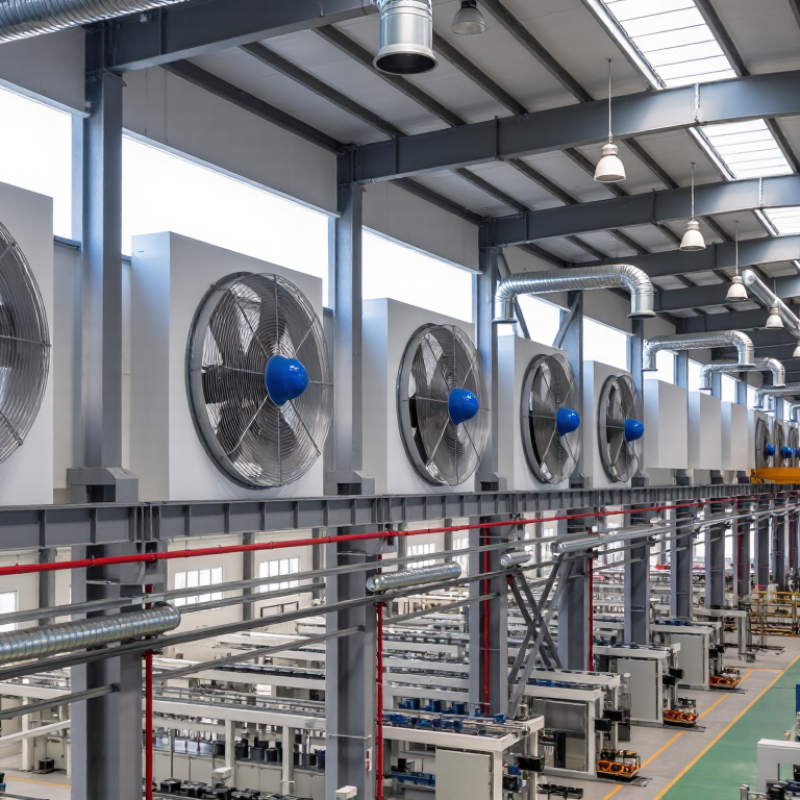
China’s industrial ventilation fan manufacturing sector combines large-scale machining with practical factory experience. Manufacturers commonly produce axial, centrifugal, roof, and explosion-resistant ventilation systems for workshops, warehouses, and processing facilities. Production often begins with airflow calculations, pressure requirements, and site measurements. Material selection follows. Galvanized steel, stainless steel, and coated alloys serve different environments.
A reliable factory should control blade balance, motor alignment, welding quality, and housing dimensions. Small errors may create vibration, noise, or reduced airflow. Dynamic balancing equipment helps correct rotating parts before assembly. Test benches can measure air volume, static pressure, power consumption, and operating sound. Certification records matter, but they should match the actual model. Paperwork alone proves little.
Chinese manufacturers also support customized voltages, impeller sizes, control systems, and corrosion-resistant finishes. Export buyers often request drawings, inspection reports, spare parts, and installation guidance. Packaging needs attention too. Long-distance transport can damage frames or bend blades when internal protection is weak. The process is not flawless. Specifications sometimes change after production starts, causing delays or costly revisions. Clear drawings and sample approval reduce this risk. Experienced engineers usually ask about dust levels, temperature, humidity, and working hours before recommending a fan. That practical questioning is valuable. A cheaper unit may appear attractive, yet its motor efficiency, bearing life, and maintenance access deserve closer inspection.
Key Criteria for Evaluating Industrial Fan Manufacturers
Choosing among China’s top industrial ventilation fan manufacturers requires more than comparing catalog airflow figures. Ask for the operating point: required airflow and static pressure under your actual duct conditions. A fan that performs well in an open test may deliver less once filters, bends, and grilles add resistance. Small details matter.
Check how the manufacturer verifies performance. Request test data, measurement conditions, and tolerances for efficiency, noise, and vibration. Confirm that the proposed materials suit the site’s temperature, humidity, dust, or corrosive exposure. Review motor specifications, control compatibility, and access for cleaning or maintenance. A clear drawing and a traceable test report are more useful than broad claims. If documents are incomplete, treat that as a question to resolve, not proof of poor quality.
Look beyond the unit price. Ask about production lead time, spare-part availability, warranty boundaries, and technical support after installation. Request references for comparable applications, while checking whether the conditions truly match yours. One point is easy to underestimate: even a careful scorecard cannot predict every installation issue. Duct layout, commissioning, and operator habits affect results too. Compare suppliers against the same written requirements, and record any assumptions. A low quote may be reasonable, but only if its exclusions are visible.
Profiles of China’s Top 10 Industrial Ventilation Fan Manufacturers
China Top 10 Industrial Ventilation Fan Manufacturers
Profiles of China’s Top 10 Industrial Ventilation Fan Manufacturers
A useful supplier profile goes beyond production volume. It should explain fan types, materials, testing, and service. The profiles below describe ten common manufacturer strengths, not an independently audited ranking. Profile 1 focuses on axial fans for moving large air volumes through open spaces. Profile 2 specializes in centrifugal fans, often used where duct resistance is higher. Profile 3 offers roof exhaust units for factories with limited wall space. Profile 4 makes corrosion-resistant equipment for humid or chemically demanding environments. Profile 5 concentrates on compact fans for machinery and small enclosures.
Profile 6 emphasizes energy-conscious motor and impeller choices. Profile 7 supports custom dimensions for older facilities, though unusual specifications may extend lead times. Profile 8 offers integrated ventilation packages, including controls and dampers. Profile 9 serves heavy industrial sites with robust housings and documented performance tests. Profile 10 provides a broad product range for buyers who need several fan types from one source. Capabilities vary by model, so verify them directly. A polished catalogue is not proof of measured performance.
Tips: Ask for a fan curve at your required airflow and pressure. Check sound levels, motor efficiency, material grade, warranty terms, and spare-part availability. Request test records for the exact model, not a similar unit. Then compare installation and maintenance needs. Small details matter.
Product Categories and Technologies Offered by Leading Manufacturers
China’s leading industrial ventilation fan manufacturers serve factories, warehouses, workshops, tunnels, and agricultural facilities. Their product ranges usually include axial fans, centrifugal fans, mixed-flow fans, roof extractors, and portable ventilation units. Axial models move large air volumes through short duct runs. Centrifugal fans provide stronger pressure for filters, long ducts, and process equipment.
Modern suppliers increasingly offer electronically commutated motors and variable-frequency drives. These technologies adjust airflow without constant full-speed operation. Temperature, humidity, pressure, and carbon dioxide sensors can control fan performance automatically. Some systems connect with PLC panels or building management platforms. Energy recovery ventilators also transfer heat between incoming and exhaust air. This reduces heating or cooling losses in controlled environments.
Material selection varies by application. Galvanized steel suits general workshops, while stainless steel supports humid or corrosive areas. Powder coatings add protection, but coating quality still needs inspection. Acoustic housings, vibration isolators, and flexible connectors help reduce mechanical noise. In practical projects, stated airflow may not match field results. Duct resistance, dirty filters, poor balancing, and installation errors often explain the difference. Reliable manufacturers therefore provide performance curves, motor data, test records, and maintenance guidance. Site testing remains essential. Even accurate specifications cannot replace a measured commissioning report.
Industrial Ventilation Fan Categories and Typical Static-Pressure Capability
Typical operating bands commonly associated with product categories offered by leading industrial ventilation fan manufacturers. Values are shown in pascals (Pa).
Axial fans generally support high air volume at relatively low pressure, while centrifugal and mixed-flow designs cover higher-pressure applications. Common technology options include variable-speed or EC motors, explosion-protected construction, high-temperature smoke extraction, corrosion-resistant materials, acoustic control, and energy-efficient impeller designs.
Applications, Standards, and Export Markets of Chinese Industrial Fans
China’s industrial ventilation fan manufacturers serve factories, warehouses, tunnels, mines, farms, and wastewater plants. Their equipment manages heat, dust, humidity, smoke, and hazardous process gases. Axial fans move large air volumes through open areas, while centrifugal fans provide stronger pressure for ducts and filtration systems.
Reliable manufacturers normally verify airflow, pressure, noise, vibration, and motor efficiency through controlled testing. Common references include ISO 5801, AMCA 210, IEC motor requirements, and ISO 13349 terminology. Export models may also require CE or UKCA documentation, depending on the destination and installation. A certificate alone is not proof of good performance. Buyers should request test curves, material specifications, protection ratings, and maintenance instructions.
Export demand is strong across Southeast Asia, the Middle East, Europe, Africa, and Latin America. Climate changes the design. Coastal projects may need corrosion-resistant coatings, while dusty factories often require sealed motors and washable components. Food facilities usually prioritize cleanable surfaces and low contamination risk. Fire and smoke applications demand separate engineering review, not ordinary ventilation equipment.
Details matter greatly. A fan can meet its catalog rating but fail after poor duct design. This happens more often than expected. Chinese suppliers with export experience usually support factory inspections, remote commissioning, spare-parts planning, and multilingual technical files. Still, project teams should check local electrical rules, acoustic limits, and installation conditions before approving production.