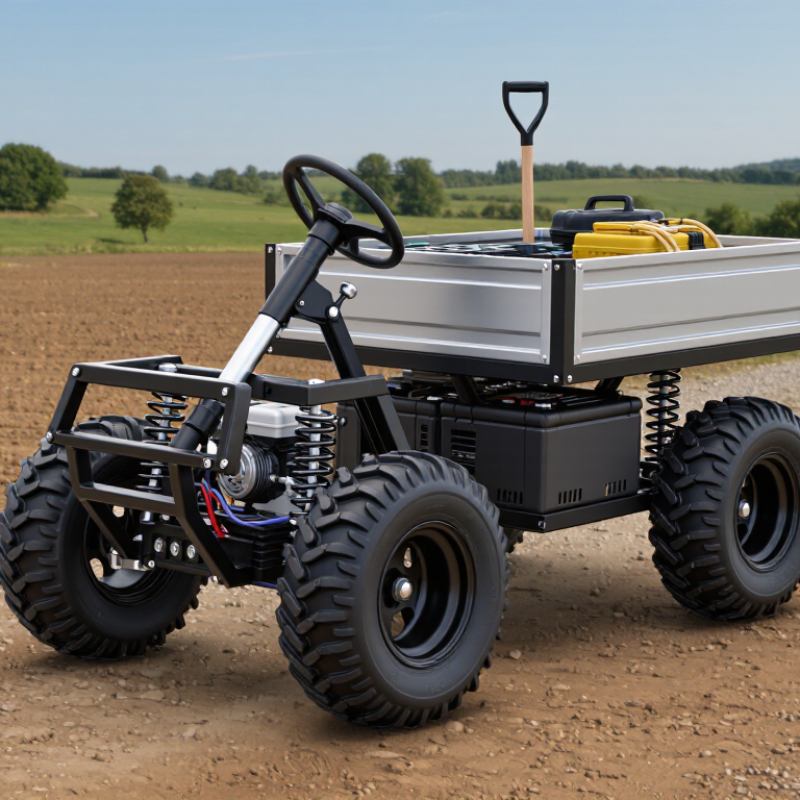
Searching for a China best Terrain Cart for sale can feel simple until specifications meet real ground conditions. Product photos often show smooth warehouse floors, not muddy paths, steep slopes, or loose gravel. Buyers should judge performance against their actual site. A cart carrying tools across a farm needs different features from one serving a resort, construction area, or large estate.
Start with payload, motor output, battery capacity, tire design, braking, and ground clearance. These details affect daily reliability. Ask for tested climbing ability, realistic operating range, charging time, and rated load. A claimed range may shrink in cold weather, on hills, or under heavy cargo. Small details matter. Check frame welds, steering response, suspension movement, and the quality of the cargo bed. If possible, request a video showing the Terrain Cart on terrain similar to yours. A short demonstration can reveal more than polished advertising.
Supplier evaluation is equally important. Review manufacturing experience, inspection procedures, spare-parts availability, warranty terms, and service response. Ask whether replacement batteries, controllers, tires, and brake components remain available after purchase. Factory certificates and export experience may support confidence, but they should not replace independent verification. Buyers should also confirm local operating, transport, and safety requirements before ordering. “Best” is not always the most powerful model. It may be the easiest to maintain. Some advertised advantages sound impressive, yet prove less useful in daily work. Careful comparison, a documented quotation, and a practical trial can reduce costly surprises.
“Terrain cart” is a marketing term, not a separate vehicle class under ANSI/ITSDF B56.8-2021. The standard addresses personnel and burden carriers. A utility cart carries tools, materials, or workers. A recreational cart mainly carries passengers on planned routes. That difference affects seating, load ratings, braking, steering, guarding, and operator training.
Do not trust the word “all-terrain” alone. ANSI/ITSDF B56.8 does not automatically approve a cart for steep trails, loose soil, or deep mud. Buyers should match the vehicle’s rated capacity with real conditions. A 500-kilogram payload can change quickly when passengers, batteries, and equipment share the platform. CPSC analysis for 2011–2020 estimated 156,040 golf-cart-related injuries in the United States, about 15,600 each year. Falls and ejections remain practical concerns. The number is sobering. It also shows why recreational use deserves utility-level caution.
Tips: Request the operator manual, data plate, brake test record, and battery details. Check the stated grade limit, ground clearance, tire type, and rollover protection. Ask whether testing followed ANSI/ITSDF B56.8. “Compliant” should mean documented, not casually printed in a listing. Buyers may also overlook weather exposure, charging ventilation, and uneven weight distribution. That is an easy mistake. For Chinese terrain cart suppliers, compare test evidence and after-sales parts support, not only price or motor power.
A terrain cart is not judged by payload alone. Buyers should compare measured payload, loaded range, and gradeability under repeatable conditions. A useful payload test records the cart, driver, tools, and cargo separately. Then, the total load is verified on a certified scale. Do not trust a headline capacity without test details.
Range should be measured with a stated payload, tire pressure, surface, temperature, and driving speed. A cart traveling 40 kilometers unloaded may travel far less across wet grass with 500 kilograms aboard. Battery age also matters. Ask for results from both new and used batteries. Short tests can mislead.
Gradeability needs careful reporting. A 15-degree slope equals about a 27 percent grade. That figure means little without knowing the surface and stopping distance. Loose gravel, mud, and a sharp turn can change performance quickly.
During field evaluations, I watch motor temperature, wheel slip, braking control, and restart ability. Small details matter. My early comparisons focused too heavily on maximum payload. That was a mistake.
A cart carrying less weight, but climbing safely and returning with usable range, may be the better purchase. Independent test records, clear limits, and service documentation provide stronger evidence than showroom claims.
When comparing a terrain cart, buyers should verify the battery voltage, not trust a sales label. A 48V system and a 72V system require different controllers, chargers, wiring, and safety settings. Higher voltage is not automatically better. Motor power, battery capacity, terrain, payload, and hill gradients matter more.
Check the battery label for nominal voltage, ampere-hours, chemistry, production date, and protection details. A 72V, 100Ah pack stores about 7.2 kWh, while a 48V, 100Ah pack stores 4.8 kWh. The larger pack may provide longer operation, but it also adds weight and charging demand. The International Energy Agency reported global electric-vehicle battery demand exceeded 750 GWh in 2023. This growth makes traceable battery information increasingly important, although small carts may use different designs.
Ask for UN 38.3 test evidence, not merely the phrase “UN 38.3 compliant.” The United Nations testing framework covers transport safety tests, including vibration, shock, and external short circuit. It does not prove excellent range or charging speed. Confirm charger output, connector type, charging temperature limits, and full-charge time. A simple estimate is battery energy divided by charger power, with losses included. For example, a 7.2 kWh battery using a 1.8 kW charger needs more than four hours. In practice, charging slows near full capacity. Buyers often overlook this detail. I would also request a cold-start test and a hill-load test, because catalog figures can feel optimistic in real terrain.
When buying a China terrain cart, check the IEC 60529 IP rating, not only the word “waterproof.” IP54 limits dust entry and resists water splashes. IP65 adds protection against water jets. IP67 allows temporary immersion under specified test conditions. These ratings do not prove corrosion resistance, connector durability, or performance after repeated vibration. Ask for the test report, test laboratory, and exact vehicle configuration. A report for an empty prototype may not represent a loaded cart.
Braking deserves a practical inspection. Confirm whether the cart uses hydraulic, mechanical, or regenerative braking. Check stopping distance on wet slopes with its maximum payload. The brake must hold the parked vehicle without constant pedal pressure. NIOSH agricultural safety materials link rollover protection structures and seat belts with sharply reduced fatal rollover risk. That evidence concerns tractors, not every terrain cart, but the lesson remains relevant. Require a certified ROPS, a properly mounted seat belt, and clear rollover instructions. Lights should include headlights, brake lamps, indicators, and rear reflectors where site rules require them. UNECE lighting guidance and relevant SAE testing practices offer useful technical references, but off-road requirements vary by location. IEC 60529 cannot replace lighting approval. It is easy to overlook mud-covered lamps. I would inspect them after a real route, not a showroom drive. Check visibility at dusk, cable sealing, warning tones, and emergency shutoff access. Some buyers focus heavily on IP67, yet weak brakes or poor rollover protection can create greater danger.
IEC 60529 IP ratings compared by solid-particle and water-ingress protection levels
Choosing the best terrain cart from a Chinese supplier requires more than comparing power, payload, and price. Buyers should verify CE documentation, applicable directives, and the Declaration of Conformity. Request test reports from a competent laboratory, not only a scanned certificate. Match every report to the exact cart model, battery, charger, and controller. Details matter. EMC evidence should show that the cart can operate near radios, sensors, and other equipment without causing interference. Paperwork is not performance.
A practical audit should include a written warranty with clear coverage periods, exclusions, and response times. Ask who pays for shipping, labor, and replacement components. Confirm the availability of tires, controllers, chargers, braking parts, and battery packs. Suppliers should provide part numbers, installation guidance, and realistic delivery estimates. A sample unit can reveal issues that documents hide, such as weak connectors, poor ground clearance, or difficult access to fuses. I have found that small maintenance details often affect daily reliability more than advertised speed.
Total cost of ownership includes energy use, scheduled service, downtime, operator training, import handling, and spare inventory. Compare these costs over three to five years, rather than focusing on the purchase invoice. Ask for service records from comparable working environments and contact verifiable references. Some suppliers may answer slowly or provide incomplete evidence. Treat that as a risk, not a minor inconvenience. A careful buyer should record every promise in the contract and review the assumptions before ordering.
| Audit Dimension | What Buyers Should Verify | Required Evidence or Test Data | Practical Buyer Benchmark | Effect on Total Cost of Ownership | Typical Risk if Unverified |
|---|---|---|---|---|---|
| Vehicle Classification | Confirm whether the cart is intended for private property, industrial sites, resorts, farms, construction areas, or public-road use. Road-legal requirements vary by destination country. | Technical specification sheet, intended-use statement, rated operating conditions, and destination-market compliance assessment. | The supplier should clearly define operating environment, maximum grade, payload, passenger capacity, and permitted speed. | Incorrect classification can create retrofit, registration, insurance, or replacement costs. | High Possible compliance and liability exposure |
| Payload and Towing Capacity | Check rated payload, passenger load, cargo-bed capacity, tongue weight, and towing capacity under the stated terrain and gradient conditions. | Load-rating documentation, axle-load data, braking test results, and controlled test video or inspection report. | Use a safety margin of at least 15–20% above the expected working load where site conditions are variable. | Overloading accelerates tire, suspension, motor, controller, and brake wear. | High Safety and premature-wear risk |
| Terrain Capability | Evaluate ground clearance, approach and departure angles, tire type, differential arrangement, traction control, water resistance, and maximum grade. | Measured ground-clearance data, tire dimensions, grade-test protocol, IP rating documentation where applicable, and operating-temperature limits. | The published gradeability should identify whether the value applies to a loaded or unloaded vehicle and on what surface. | Insufficient traction or cooling capacity increases recovery, downtime, and drivetrain-repair costs. | High Performance may differ substantially from marketing claims |
| CE Documentation | Determine whether the product falls under applicable European Union legislation and whether the supplier has completed the correct conformity assessment. | EU Declaration of Conformity listing the exact model, applicable directives or regulations, standards used, responsible entity, date, and signature. | The document should match the delivered model and configuration; a generic CE logo or certificate alone is not sufficient evidence. | Missing or inaccurate documentation can delay customs clearance, market entry, or customer acceptance. | High Regulatory and import risk |
| EMC Compliance | Verify electromagnetic emissions and immunity performance for the complete cart, including charger, motor controller, display, lighting, and accessories. | EMC test report from a competent laboratory, test configuration, applicable standards, serial or model reference, and corrective-action records if failures occurred. | The test configuration should represent the final production vehicle rather than an unrelated prototype. | EMC failures may cause instrument resets, radio interference, warranty returns, or site-equipment disruption. | High Unplanned re-testing and field-failure risk |
| Electrical Safety | Review battery isolation, over-current protection, cable routing, connector ratings, charger protection, emergency disconnect, and insulation protection. | Wiring diagram, fuse and breaker schedule, insulation-resistance results, charger specification, battery safety data, and production inspection records. | Protection devices should be correctly rated for the battery voltage, maximum current, cable size, and environmental conditions. | Weak electrical protection increases fire, battery, controller, and downtime costs. | High Potential safety hazard |
| Battery System | Compare battery chemistry, nominal voltage, usable energy, cycle-life conditions, charge time, low-temperature behavior, battery-management system, and replacement method. | Battery datasheet, BMS specification, capacity test method, charging profile, warranty terms, and replacement-price quotation. | Compare usable energy and expected service life, not only nominal ampere-hours or purchase price. | Battery replacement is often one of the largest long-term operating expenses. | Medium Lifecycle cost may be understated |
| Energy Consumption | Measure energy use under a defined payload, speed, distance, terrain, temperature, and stop-start pattern. | Wh/km or kWh per operating hour, test conditions, charger efficiency, and battery recharge records. | Use a site-specific duty cycle; a laboratory or unloaded range figure should not be treated as normal operating range. | Energy cost can be estimated as: energy used × electricity tariff × annual operating hours or distance. | Medium Operating-cost estimates may be unreliable |
| Warranty Coverage | Separate vehicle, battery, charger, motor, controller, frame, and wearable-part coverage. Check exclusions for commercial use, overload, water ingress, and unauthorized repairs. | Signed warranty terms, claim procedure, response time, labor coverage, shipping responsibility, and list of excluded components. | A clear written warranty is more valuable than a headline duration; battery coverage should state capacity-retention conditions where applicable. | Ambiguous exclusions can transfer major repair and freight costs to the buyer. | High Dispute and downtime risk |
| Spare Parts Availability | Check availability of tires, brake components, suspension parts, belts, bearings, lights, switches, controllers, chargers, batteries, and body panels. | Exploded parts diagram, part numbers, current price list, stock policy, minimum order quantities, and expected lead times. | Require a service-parts list before purchase and identify commonly replaced parts that can be stocked locally. | Long lead times increase rental, labor, transport, and lost-operation costs. | High Downtime risk |
| Serviceability | Assess access to batteries, fuses, controller, brake adjustments, diagnostic ports, lubrication points, and service manuals. | Workshop manual, preventive-maintenance schedule, diagnostic procedure, fault-code list, and technician training plan. | Routine inspections should be possible with standard tools and without removing major assemblies. | Good serviceability reduces labor hours and improves fleet availability. | Medium Higher maintenance labor |
| Quality-Control Process | Review incoming inspection, welding checks, torque control, electrical testing, road testing, final inspection, and traceability. | Quality manual, inspection checklist, sample inspection records, serial-number system, and pre-shipment inspection report. | Ask for acceptance criteria and records for the exact batch, not only general factory photographs. | Consistent quality lowers return rates, field repairs, and replacement freight. | Medium Batch-to-batch variation |
| Supplier Verification | Confirm legal entity, manufacturing capability, export history, production location, subcontracted components, and after-sales responsibility. | Business registration information, factory audit, production records, references for comparable applications, and signed commercial documents. | The contracting entity, invoice entity, warranty provider, and technical-document issuer should be clearly identified and consistent. | Weak supplier continuity can make warranty and spare-parts recovery difficult. | High Commercial continuity risk |
| Landed Cost | Calculate product price plus packaging, inland transport, freight, insurance, customs duties, taxes, inspection, assembly, and local delivery. | Pro forma invoice, Incoterms, carton dimensions, gross weight, tariff classification, freight quotation, and destination charges. | Compare suppliers using the same Incoterms, configuration, battery, charger, accessories, and delivery destination. | Low factory pricing can be offset by freight, duty, battery handling, or installation costs. | Medium Budget overrun risk |
| Total Cost of Ownership | Model purchase, energy, scheduled maintenance, tires, batteries, repairs, spare parts, labor, downtime, financing, disposal, and resale value. | Five-year cost model using supplier quotations, site duty-cycle data, maintenance intervals, expected battery life, and downtime assumptions. | Use sensitivity cases for energy price, annual usage, battery replacement timing, repair frequency, and downtime cost. | TCO formula: acquisition cost + logistics + energy + maintenance + repairs + battery replacement + downtime − residual value. | High Lowest purchase price may not be the lowest-cost option |
| Buyer decision rule: select the configuration with documented compliance, verifiable test conditions, dependable parts support, and the lowest risk-adjusted five-year TCO—not simply the lowest quoted price. | |||||
Rob was always very honest and upfront about everything and took the time to explain everything I needed.
“highly recommended. They provided us with a great storage container with ontime services.”
“Bought a used container, its perfect, no leaks and in good condition.”
“Good service and prompt delivery. A great option for temporary storage at a decent price.”
Join our mailing list to get the latest storage container inventory and offers